
Building a B2B Sales Pipeline from Zero in a New Asian Market
A practical step-by-step playbook for creating qualified pipeline before overcommitting to hiring, offices, or expansion costs
Entering a new Asian market can feel exciting on paper.
The region is large, commercially active, and increasingly digital. ASEAN alone had 684.1 million people in 2024, alongside US$3.84 trillion in trade in goods, US$1.29 trillion in trade in services, and US$230.8 billion in foreign direct investment. Southeast Asia’s digital economy also surpassed US$300 billion in GMV in 2025, according to the e-Conomy SEA 2025 report by Google, Temasek, and Bain.
But a large market does not automatically become pipeline.
Many B2B companies enter Asia with enthusiasm but no repeatable sales motion. They may have a strong product, a few referrals, and positive conversations, but they do not yet know:
- which market to prioritise;
- which buyer persona responds;
- which pain point creates urgency;
- which channel works;
- what level of localisation is needed;
- whether meetings convert into real opportunities;
- when to hire locally;
- whether to outsource, partner, or build internally.
That is why the first goal should not be “scale Asia immediately.”
The first goal should be:
Build a repeatable pipeline motion in one priority market before expanding the playbook.
This guide explains how to build a B2B sales pipeline from zero in a new Asian market—without relying on guesswork, random referrals, or a premature hiring plan.
- TL;DR — Key Takeaways
- Start with market prioritisation, not outreach. Choose the country and segment where your ICP, proof, price point, and buyer access are strongest.
- Define a narrow ICP before building a list. A small, focused account list is more valuable than thousands of poorly matched prospects.
- Validate the buyer problem before scaling volume. Early pipeline building is about learning as much as booking meetings.
- Use a multichannel motion. McKinsey reports that B2B customers now use ten or more channels during supplier interactions, which reinforces the need for coordinated outreach rather than one isolated channel.
- Measure pipeline quality, not just activity. Emails sent, LinkedIn requests, and calls made are not enough. Track meetings held, sales-accepted opportunities, pipeline value, and market feedback.
- Do not hire too early. Build evidence first, then decide whether to hire, outsource, partner, or use a hybrid model.
- Document the playbook before expanding. If the first market is not repeatable, adding another market usually spreads the same problems.
If you only do one thing: validate one market, one ICP, and one outreach motion before expanding across Asia.
Who This Comparison Is For (and Not For)
This Guide Is For
- B2B companies entering Asia for the first time.
- Founders testing whether a new Asian market is worth investing in.
- CEOs and CROs building a business case for regional expansion.
- Sales leaders responsible for pipeline in Singapore, ASEAN, India, Japan, Korea, or wider APAC.
- Country managers tasked with creating demand before a full local team exists.
- SDR and GTM teams building account lists, outbound campaigns, and qualification systems from scratch.
- Companies deciding between hiring locally, outsourcing sales development, using partners, or running a hybrid model.
This guide is especially relevant for companies selling:
- B2B SaaS;
- cybersecurity;
- cloud and managed services;
- fintech;
- HR technology;
- healthtech;
- professional services;
- data and AI platforms;
- enterprise software;
- market-entry or regional expansion services.
This Guide Is Not For
This guide may be less useful if:
- your product has not achieved product-market fit anywhere;
- you are looking for consumer lead generation;
- your sales cycle is purely transactional and low-ticket;
- your team wants to launch across every Asian market at once;
- you are unwilling to adapt messaging by country, role, or buyer maturity;
- you cannot follow up quickly on qualified meetings;
- you only want brand awareness without sales pipeline accountability.
Practical fit check: This guide is for companies that need qualified conversations, market learning, and early opportunity creation—not just more contacts in a spreadsheet.
Why Building Pipeline from Zero Is Different in Asia
Building pipeline in a new Asian market is not the same as expanding inside a familiar home market.
There may be no local brand awareness.
There may be no local customer proof.
The buyer may not know your category.
The decision-maker may not sit where you expect.
Your global value proposition may need adjustment.
Your pricing may need to be tested.
Your usual outreach channel may underperform.
Your buyer may require more education, trust, references, or local context before taking a meeting.
The Main Challenge
Most companies do not fail because Asia has no opportunity.
They fail because they confuse market size with market readiness.
A big market does not mean:
- your ICP is present;
- your buyer is accessible;
- your message is relevant;
- your price point fits;
- your proof is credible;
- your sales cycle is manageable;
- your internal team can close remotely.
Pipeline building is the process of turning market assumptions into evidence.

Step 1 — Choose the Right First Market
Do not begin by saying:
“We want to enter Asia.”
That is too broad.
Asia includes mature hubs, emerging growth markets, multilingual buyer environments, enterprise-heavy sectors, founder-led ecosystems, and relationship-driven commercial cultures.
Start with one priority market.
Market Prioritisation Criteria
| Factor | Questions to Ask |
| ICP density | Are enough target companies present in this market? |
| Buyer accessibility | Can we reach decision-makers through LinkedIn, email, phone, events, referrals, or partners? |
| Problem urgency | Does the market clearly feel the pain we solve? |
| Pricing fit | Can buyers realistically afford our solution? |
| Proof relevance | Do we have case studies or customer examples that will resonate? |
| Language and localisation | Can we communicate effectively with target buyers? |
| Competitive intensity | Are buyers already educated, saturated, or underserved? |
| Internal closing capacity | Can our team support discovery, proposals, and follow-up? |
| Regulatory complexity | Are there major legal, privacy, licensing, or procurement barriers? |
Practical Market Sequence
A common approach is to start with a market where:
- buyers are easier to research;
- English or business English is workable;
- the company has some regional proof;
- the pricing is acceptable;
- the internal team can support sales calls;
- the sales motion can be tested quickly.
For many companies, this may be Singapore.
For others, it may be Malaysia, the Philippines, India, Australia, Indonesia, Vietnam, Japan, or Korea.
The right first market depends on your ICP—not on habit.
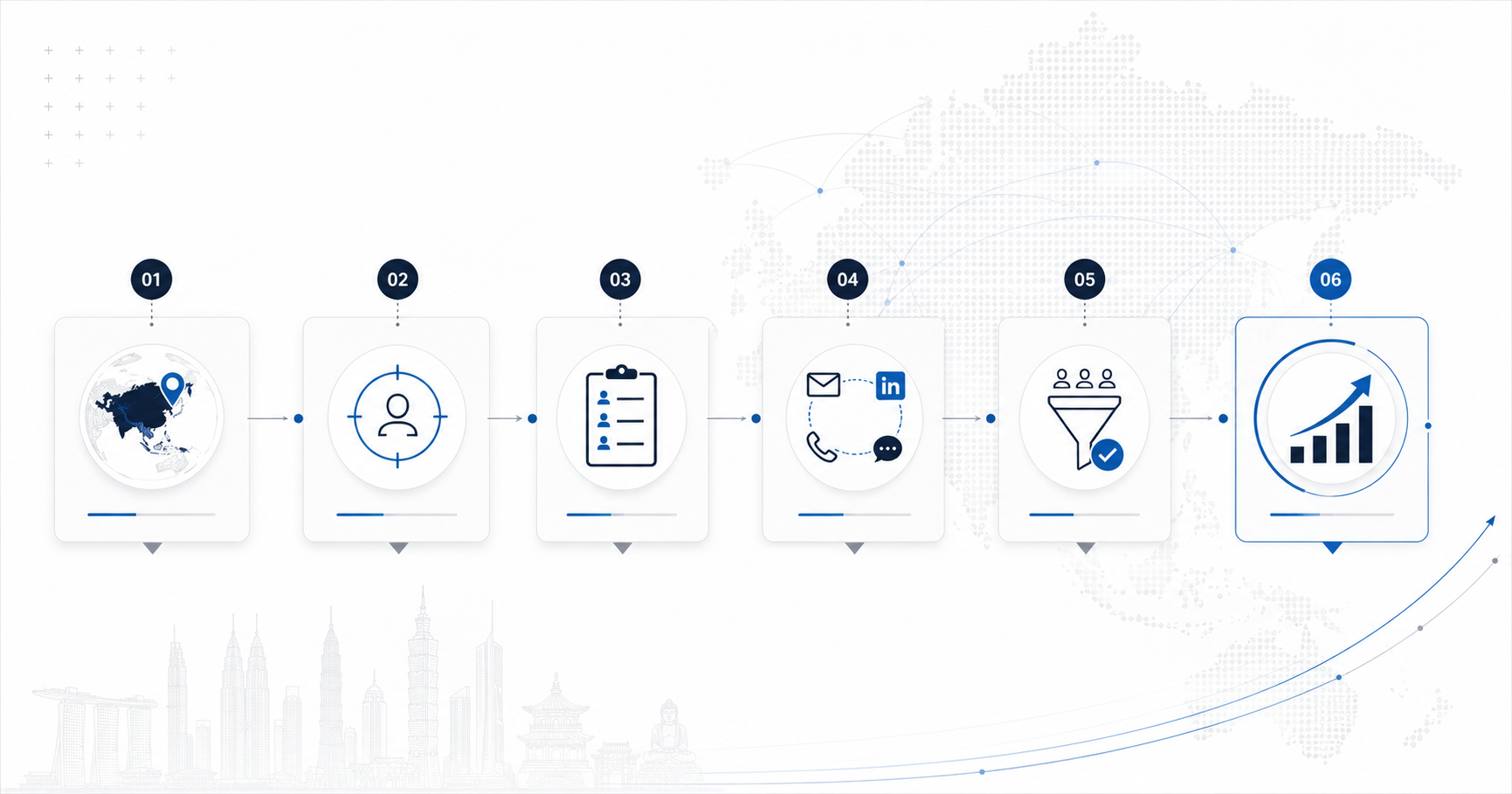
Step 2 — Define a Narrow Market-Entry ICP
A broad ICP creates weak pipeline.
A strong first-market ICP should be narrow enough to test properly.
Weak ICP
Mid-market companies in Asia.
Better ICP
Singapore-based B2B SaaS and professional-services companies with 50–500 employees, regional growth responsibilities, and a need to create qualified outbound pipeline across Southeast Asia.
What to Define
| ICP Element | Example |
| Geography | Singapore-based regional HQ teams |
| Industry | SaaS, fintech, cybersecurity, professional services |
| Company size | 50–500 employees |
| Buyer roles | CEO, CRO, Country Manager, Head of Sales |
| Pain point | Insufficient qualified pipeline |
| Trigger | Regional expansion, hiring, funding, new market entry |
| Budget fit | Can support outsourced or internal GTM investment |
| Disqualifiers | Agencies, students, recruiters, micro-businesses, competitors |
Why Narrow Works Better
A narrow ICP helps you:
- write sharper messages;
- build better account lists;
- test real buyer response;
- identify common objections;
- compare conversion rates;
- improve qualification;
- understand where pipeline actually comes from.
Once one segment works, you can expand.
Step 3 — Build Your First Target-Account List
Your first target-account list does not need to be massive.
It needs to be accurate.
Suggested Starting Point
For a new market test:
| Market Test Stage | Suggested Account Count |
| Initial validation | 50–100 accounts |
| First outbound campaign | 100–300 accounts |
| Expanded test | 300–700 accounts |
| Scaling stage | 700+ accounts |
These are planning ranges, not fixed benchmarks.
What to Include
At account level:
- company name;
- website;
- industry;
- market presence;
- company size;
- regional relevance;
- trigger event;
- account tier;
- pain hypothesis;
- source;
- CRM status.
At contact level:
- name;
- title;
- seniority;
- department;
- email;
- phone if available;
- LinkedIn profile;
- role in buying process;
- verification status;
- outreach owner.
Build by Account First
Do not simply collect contacts.
First identify the accounts worth pursuing, then map the right people inside those accounts.
This reduces wasted outreach.
Step 4 — Map the Buying Committee
In a new Asian market, the first person you contact may not be the final decision-maker.
B2B buying may involve:
- local country leadership;
- regional leadership;
- functional heads;
- finance;
- procurement;
- technical evaluators;
- internal users;
- external consultants;
- group headquarters.
Buying Committee Map
| Role | Purpose |
| Economic buyer | Owns budget or final approval |
| Business owner | Feels the problem directly |
| Technical evaluator | Reviews implementation, security, integration, or feasibility |
| Internal champion | Supports the project internally |
| Procurement | Manages vendor process and contracts |
| Regional approver | Influences multi-country rollout |
| Referrer | Helps identify the correct stakeholder |
What to Do
For each Tier 1 account, map at least:
- one senior decision-maker;
- one functional owner;
- one possible influencer;
- one referral path if available.
This is especially important when entering markets where hierarchy, relationships, or internal consensus play a major role.
Step 5 — Create Market-Relevant Messaging
Your global pitch may not work unchanged.
A new market needs messaging that explains:
- why the problem matters locally;
- why your company is credible;
- why the timing makes sense;
- why the buyer should speak with you now.
Message Components
| Component | Purpose |
| Relevance | Why this account, role, or market? |
| Problem | What business issue are you addressing? |
| Proof | Why should the buyer believe you? |
| Perspective | What useful insight can you offer? |
| CTA | What next step is easy to accept? |
Example Message
Hi Sarah, noticed your team is expanding commercial activity across Southeast Asia.
We often see B2B companies at this stage generate early referrals, but struggle to turn that into a repeatable pipeline motion.
We help teams validate target accounts, run localised outreach, and create qualified conversations before committing to full local headcount.
Curious if building predictable pipeline in Singapore or ASEAN is currently part of your priorities?
What to Avoid
Avoid:
- “We are the leading provider…”
- generic Asia expansion claims;
- overuse of AI-written wording;
- no market context;
- asking for a demo too early;
- assuming pain without asking.
The goal is to create a conversation, not force a meeting.
Step 6 — Choose Your First Outreach Channels
Do not launch every channel immediately.
Start with the channels most likely to reach your ICP.
McKinsey’s B2B research has repeatedly shown the importance of omnichannel buying and selling, including findings that B2B customers regularly use ten or more channels to interact with suppliers. Its 2024 B2B Pulse research also states that most decision-makers use ten or more interaction channels along the buying journey.
For a new-market pipeline test, this does not mean you need ten channels at once.
It means you should avoid depending on one channel alone.
Recommended First Channel Mix
| Channel | Role |
| Research, visibility, relationship entry | |
| Cold email | Structured outreach and scale |
| Phone | Qualification and follow-up |
| Webinars | Education and trust-building |
| Referrals | Credibility and senior access |
| Events | Market presence and warm conversations |
| Partners | Local credibility and introductions |
Example First-Market Sequence
- Identify target accounts.
- View and research the buyer on LinkedIn.
- Engage with relevant content.
- Send a short email.
- Send a LinkedIn connection request.
- Follow up with a practical insight.
- Call where appropriate.
- Invite to a webinar or short market discussion.
- Qualify and route to sales.
This creates multiple ways for the buyer to recognise and engage with your company.
Step 7 — Run a Controlled 90-Day Pipeline Test
A 90-day test is usually enough to learn whether the first market has real potential.
The goal is not to prove the entire revenue forecast.
The goal is to validate:
- ICP fit;
- list quality;
- message relevance;
- channel response;
- meeting quality;
- early opportunity creation.
Days 1–30 — Foundation
Focus on:
- market selection;
- ICP definition;
- list building;
- buyer mapping;
- message development;
- CRM setup;
- qualification criteria.
Days 31–60 — Outreach
Focus on:
- LinkedIn engagement;
- cold email;
- follow-up calls;
- reply analysis;
- objection tracking;
- meeting booking;
- early market feedback.
Days 61–90 — Qualification and Pipeline
Focus on:
- meetings held;
- sales acceptance;
- opportunity creation;
- pipeline value;
- segment comparison;
- channel performance;
- next-market decision.
What to Learn
At the end of 90 days, you should know:
- which buyer roles responded;
- which message worked best;
- which objections appeared repeatedly;
- which channels created real conversations;
- whether meetings were accepted by sales;
- whether opportunities are forming;
- whether the market deserves more investment.
Step 8 — Qualify Meetings Properly
A meeting is not automatically pipeline.
A qualified meeting should include:
| Qualification Area | What It Means |
| Account fit | The company matches the ICP |
| Persona fit | The contact has influence or decision relevance |
| Problem fit | There is a relevant business issue |
| Timing | There is a reason to explore now or soon |
| Commercial fit | The company can support your price point |
| Meeting clarity | The buyer understands why the meeting is happening |
| Next step | There is a reasonable path after the first conversation |
Written Qualification Definition
Before launching outreach, define:
- what counts as a qualified meeting;
- what disqualifies a meeting;
- what information must be captured;
- who accepts or rejects the meeting;
- how feedback is given.
This prevents the classic problem:
Marketing says the lead is qualified. Sales says it is not.
Step 9 — Set Up CRM, Reporting, and Feedback Loops
Your CRM should not become an afterthought.
If the market test is not tracked properly, you will not know what worked.
Minimum CRM Fields
- account name;
- country;
- industry;
- company size;
- buyer persona;
- lead source;
- outreach channel;
- trigger;
- message angle;
- qualification status;
- meeting status;
- opportunity status;
- disqualification reason;
- next step;
- owner.
Weekly Reporting
Track:
- accounts researched;
- contacts added;
- outreach sent;
- positive replies;
- meetings booked;
- meetings held;
- show rate;
- sales-accepted meetings;
- opportunities created;
- top objections;
- market feedback.
Feedback Loop
Sales should provide feedback within 24–48 hours after meetings.
Capture whether the meeting was:
- qualified opportunity;
- nurture;
- wrong persona;
- wrong account;
- no active problem;
- timing issue;
- no budget;
- no-show;
- duplicate opportunity.
Without feedback, the campaign cannot improve.
Step 10 — Convert Early Meetings Into Pipeline
The first meeting in a new market has two jobs:
- qualify the opportunity;
- learn the market.
What Discovery Should Cover
- Why did the buyer agree to speak?
- What problem are they trying to solve?
- How are they handling it today?
- Who else is involved?
- What happens if nothing changes?
- Is there budget or business case potential?
- What timing is realistic?
- What would make a solution credible?
- What proof do they need?
- What is the next step?
Meeting-to-Pipeline Criteria
A meeting should become an opportunity only if:
- there is a real business issue;
- the account fits the ICP;
- the buyer has influence;
- the problem is relevant to your solution;
- timing is not purely theoretical;
- a next step is agreed.
Early-stage pipeline quality matters more than pipeline quantity.
Step 11 — Decide When to Scale
Do not scale because activity looks good.
Scale when there is evidence.
Market-Readiness Gate
Before increasing spend, hiring, or expanding, confirm:
- target accounts exist in sufficient volume;
- buyers respond to at least one message angle;
- meetings are being held;
- sales accepts the meetings;
- early opportunities are forming;
- objections are understood;
- the team can follow up properly;
- unit economics make sense;
- the market can support your price point.
Three Scaling Options
1. Scale Within the Same Segment
Increase account coverage in the same ICP.
Best when the first segment is working.
2. Expand to Adjacent Personas or Industries
Keep the same market but test nearby segments.
Best when response is positive but volume is limited.
3. Enter a Second Market
Adapt the playbook to a new country.
Best only after the first market has clear evidence.
Do not copy the campaign blindly. Adapt the ICP, message, channel mix, proof, and qualification criteria.
Step 12 — Build, Outsource, Partner, or Go Hybrid?
Once early pipeline starts forming, the next question is operating model.
Option 1 — Build Internally
Best when:
- the market is strategically important;
- pipeline is validated;
- sales cycle requires deep product expertise;
- the company can afford local hiring;
- long-term market ownership matters.
Option 2 — Outsource Sales Development
Best when:
- you need speed;
- the market is still being validated;
- you lack local prospecting capacity;
- you want to reduce hiring risk;
- you need pipeline before building a full team.
Option 3 — Partner-Led Entry
Best when:
- local credibility is essential;
- implementation requires local support;
- enterprise accounts need referrals;
- channel ecosystems influence buying.
Option 4 — Hybrid Model
Best when:
- internal team owns strategy and closing;
- outsourced partner handles research and outreach;
- partners support credibility and introductions;
- market learning feeds back into GTM decisions.
Operating Model Comparison
| Model | Speed | Control | Cost Commitment | Best Use Case |
| Internal build | Medium | High | High | Proven market and long-term investment |
| Outsourced SDR | High | Medium | Medium | Market validation and early pipeline |
| Partner-led | Medium | Medium | Variable | Relationship-led markets |
| Hybrid | High | High-Medium | Medium | Controlled expansion with flexible execution |
Common Mistakes to Avoid
Mistake 1 — Starting With Hiring
Hiring before validating the market can create fixed cost before pipeline exists.
Mistake 2 — Targeting Too Broadly
A broad market brief produces weak messages and unclear learning.
Mistake 3 — Treating Referrals as a Strategy
Referrals help, but they are not a repeatable pipeline engine on their own.
Mistake 4 — Using One Message Across Asia
Markets differ. Buyer expectations differ. Channels differ.
Mistake 5 — Measuring Activity Instead of Pipeline
Outreach volume is not the goal. Sales-accepted pipeline is.
Mistake 6 — No Local Proof
Buyers may need regional examples, comparable customer stories, or local credibility.
Mistake 7 — Slow Follow-Up
Early market interest disappears quickly when nobody responds.
Mistake 8 — No Disqualification Rules
Bad-fit meetings create false confidence and waste sales time.
Mistake 9 — Expanding Too Soon
A weak motion does not improve when copied into another market.
Mistake 10 — Ignoring Data Governance
When running cross-border prospecting, companies should consider data handling, vendor governance, and transfer safeguards. ASEAN’s Model Contractual Clauses are intended as baseline clauses for businesses using cross-border data transfers across ASEAN member states.
New-Market Pipeline Scorecard
Score each category from 1 to 5.
| Area | 1 — Weak | 3 — Developing | 5 — Strong |
| Market selection | Broad Asia target | Basic country focus | Evidence-based priority market |
| ICP | Generic B2B audience | Some segmentation | Narrow, testable ICP |
| Account list | Unverified contacts | Basic company list | Verified, tiered target accounts |
| Buyer map | One contact per account | Basic role mapping | Multi-stakeholder account map |
| Messaging | Generic pitch | Market-aware message | Persona, trigger, and proof-based message |
| Channels | One channel only | Two-channel test | Coordinated multichannel motion |
| Qualification | Meeting equals qualified | Basic filters | Written qualification criteria |
| CRM | Scattered tracking | Partial reporting | Full funnel and feedback visibility |
| Sales follow-up | Ad hoc | Assigned owner | SLA-based follow-up and feedback |
| Scaling decision | Based on optimism | Based on activity | Based on accepted pipeline evidence |
Score Interpretation
| Total Score | Recommendation |
| 42–50 | Strong foundation for scaling |
| 34–41 | Good early motion; improve weaker areas before expanding |
| 25–33 | Continue validation before increasing investment |
| Below 25 | Rebuild the market-entry foundation |
Building Your First B2B Pipeline in Asia?
Expand In Asia helps B2B companies build early pipeline in new Asian markets through:
- market prioritisation;
- ICP validation;
- account research;
- LinkedIn and email outreach;
- appointment setting;
- lead qualification;
- CRM reporting;
- market feedback.
Talk to Expand In Asia about building your first qualified pipeline in Asia →
15. Next Steps With Expand In Asia
Building a B2B sales pipeline from zero is not about doing everything at once.
It is about proving the market step by step.
The strongest approach is usually:
- choose the right first market;
- define a narrow ICP;
- build a focused target-account list;
- map the buying committee;
- test relevant messaging;
- run controlled multichannel outreach;
- qualify meetings properly;
- track pipeline and feedback;
- scale only after evidence appears.
For broader market-entry planning, read:
Go-to-Market (GTM) Strategies for Asia
For additional pipeline tactics, read:
10 Best B2B Qualified Lead Generation Strategies for 2026
Schedule a consultation with Expand In Asia →
Ready to Implement These Strategies?
Book a free 30-minute strategy session where we’ll audit your current growth approach and identify your highest-leverage opportunities in Asian markets.
Frequently Asked Questions
1. How do you build a B2B sales pipeline from zero in a new Asian market?
Start by choosing one priority market, defining a narrow ICP, building a verified target-account list, mapping decision-makers, creating market-relevant messaging, running controlled outreach, qualifying meetings, and tracking pipeline outcomes in CRM.
2. Which Asian market should we enter first?
There is no universal first market.
Choose based on ICP density, buyer accessibility, pricing fit, proof relevance, language requirements, regulatory complexity, and your internal ability to support discovery and follow-up.
3. Should we hire a local salesperson first?
Not always.
If the market is unvalidated, it may be better to test pipeline through outsourced sales development, founder-led outreach, partners, or a hybrid model before committing to permanent local headcount.
4.How long does it take to build early pipeline?
A 90-day test can usually validate early signals such as list quality, buyer response, messaging, meetings held, and early opportunity creation.
Full revenue conversion may take longer depending on sales cycle and deal complexity.
5. What channels work best for building pipeline in Asia?
The best channel mix depends on the market and buyer. Common channels include LinkedIn, cold email, phone, webinars, events, referrals, and partner-led introductions.
McKinsey’s B2B research highlights that buyers use many channels during supplier interactions, so a coordinated multichannel approach is usually stronger than relying on one channel alone.
6. What is the difference between leads and pipeline?
A lead is a contact or account that may be relevant.
Pipeline refers to qualified opportunities that sales has accepted and is actively progressing.
A campaign can generate many leads but very little real pipeline if qualification is weak.
7. What should we measure in the first 90 days?
Track:
- target accounts researched;
- contacts mapped;
- positive replies;
- meetings booked;
- meetings held;
- show rate;
- sales acceptance;
- opportunity creation;
- market feedback;
- disqualification reasons.
8. When should we scale into another Asian market?
Scale only after the first market has validated ICP fit, message resonance, meeting quality, sales acceptance, and early opportunity evidence.
If the first market is unclear, adding another country usually creates more noise.